Tuesday, 9 October 2012
David Ruffle's Sherlock Holmes/Lyme Regis Blog: A giveaway!! Now starts October 10th!!
David Ruffle's Sherlock Holmes/Lyme Regis Blog: A giveaway!! Now starts October 10th!!: Sherlock Holmes and the Lyme Regis Trials, the last in the Sherlock Holmes/Lyme Regis trilogy has a publication date of December 10th......I...


Haunted Edinburgh
 The Case of the Edinburgh Haunting by David Wilson is a first-rate pastiche and is extremely well-written. Edinburgh itself is in some ways the star of the show here just as it is in Ian Rankin's Rebus novels, Victorian Edinburgh comes to life under Mr Wilson's skilful pen. One aspect which will cheer any Holmes devotee is the appearance of none other than Dr Joseph Bell who, according to ACD, was the original template for the character of Holmes. Having the two of them meet and dazzle together is David Wilson's masterstroke; I am not sure if it has been done before, but if it has I doubt it has been accomplished so well as it has here. I found myself re-reading that section three times before moving on! The action is presented to us from various viewpoints which works very well indeed. Watson's own narrative is uncannily spot on and one of the finest of recent Watsonian voices I have come across. The plot initially takes us to a haunted house in Edinburgh (one of many such there one would imagine), but not all is how it seems and the plot moves on from there to encompass murder and corruption. All the developments are handled very well and the pace never flags (it's a gentle kind of pace, a Watsonian pace if you will), The differing perspectives as the plot unfolds serve to give the reader a very clear, concise view on what is going on. The characters are well-drawn (some taken from life as in the case of Dr Bell) and in Constable Morthouse, the young officer who initially is assumed to be out of his depth, we have a policemen worthy of the highest praise from Holmes. He is keen, observant and remains focused in spite of being treated badly by his superior officer. This is a superior pastiche which will leave one wanting more from the pen and imagination of David Wilson, it certainly did for me.
The Case of the Edinburgh Haunting will be published by MX Publishing on the 17th of October, and will be available from Amazon UK, Amazon USA, and more places than you can shake a stick at!
Saturday, 6 October 2012
A Snowman review......
The first review of 'Sherlock Holmes and the Missing Snowman' by 'The Well Read Sherlockian'.
I know, I know, I’m not ready for snow yet, either. But that was before I got the marvelous opportunity to review David Ruffle’s new children’s book, pre-publication. A prolific writer, Mr. Ruffle now has six published books featuring Holmes and Watson to his credit, and is finishing up the seventh. Most of his books are intended for older readers; Sherlock Holmes and the Missing Snowman, however, is meant for a younger audience–much younger
When I heard that Mr. Ruffle was going to publish “Henrietta’s Problem” as a children’s book, I figured he’d just cut the text into smaller chunks, take out some words and be done with it.** Instead, he’s re-written the story to a child’s level, without losing any of its original charm. In fact, after reading back through the original, I actually think that this simpler version is the best. Mr. Ruffle has a gift for expressing emotion without a lot of verbal clutter, and it’s used here to great effect. The Missing Snowman reads out loud extremely well (more on this in a minute), and Lyme Regis artist Rikey Austin’s soft, nostalgic illustrations, done in a light, wintry palette, add to its gentle mood. It is a simple, touching story that reminds us that, no matter what he wants others to think, the Great Detective is much more than a logical machine.
Read the full review and much more at The Well Read Sherlockian and 'Sherlock Holmes and the Missing Snowman' is available to pre-order at Amazon UK, Amazon USA, Waterstones and many more sites and bookshops.

I know, I know, I’m not ready for snow yet, either. But that was before I got the marvelous opportunity to review David Ruffle’s new children’s book, pre-publication. A prolific writer, Mr. Ruffle now has six published books featuring Holmes and Watson to his credit, and is finishing up the seventh. Most of his books are intended for older readers; Sherlock Holmes and the Missing Snowman, however, is meant for a younger audience–much younger
When I heard that Mr. Ruffle was going to publish “Henrietta’s Problem” as a children’s book, I figured he’d just cut the text into smaller chunks, take out some words and be done with it.** Instead, he’s re-written the story to a child’s level, without losing any of its original charm. In fact, after reading back through the original, I actually think that this simpler version is the best. Mr. Ruffle has a gift for expressing emotion without a lot of verbal clutter, and it’s used here to great effect. The Missing Snowman reads out loud extremely well (more on this in a minute), and Lyme Regis artist Rikey Austin’s soft, nostalgic illustrations, done in a light, wintry palette, add to its gentle mood. It is a simple, touching story that reminds us that, no matter what he wants others to think, the Great Detective is much more than a logical machine.
Read the full review and much more at The Well Read Sherlockian and 'Sherlock Holmes and the Missing Snowman' is available to pre-order at Amazon UK, Amazon USA, Waterstones and many more sites and bookshops.
Friday, 5 October 2012
A giveaway!!
Sherlock Holmes and the Lyme Regis Trials, the last in the Sherlock Holmes/Lyme Regis trilogy has a publication date of December 10th......I have five copies to give away via Goodreads...just click the link below to be in with a chance. Good luck!
Goodreads Giveaway
Or if you prefer to buy it (!!); it's available here: Amazon UK, Amazon USA, Waterstones, The Book Depository, and many more.

Goodreads Giveaway
Or if you prefer to buy it (!!); it's available here: Amazon UK, Amazon USA, Waterstones, The Book Depository, and many more.
Wednesday, 3 October 2012
Interview time again......
I recently took the time out to fire some questions at Fiona-Jane Brown, writer, playwright, story-teller and folklorist and here is what she had to say:
Most people would consider Scotland to be a hotbed of folklore without knowing anymore than that. How does the folklore of Scotland differ from the rest of the UK for instance?
Ah, now that’s a question that I can’t really answer – you are better asking how the regions within in Scotland differ from each other! The fishing and farming communities have different folklore, as does the town compared to the country. From what I studied in my Masters, England has as much folklore as we do. It does still follow that more isolated places keep their traditions for longer – when I visited the island of Barra in the Outer Hebrides, almost the whole community are Catholic and very much trust in their religious folk rituals. On the other hand, Shetland, which is the most progressive economic area in Scotland, many of the locals, even those in their 20s are aware of ghostlore and their Norse traditions. You cannot generalise.
You are a noted expert on the cultural beliefs of fishing communities of Scotland. Could you elaborate a little on that?
I received my doctorate in Ethnology in 2010 for writing about the beliefs and identity of fisher people in three areas of Scotland, the North East, where I’m from; Shetland, and the Outer Hebrides. Again, you cannot generalise about people, but there are many traditions which fishermen share despite differences in culture and religion. Nearly every one of the areas I worked in had examples of the “Burning of the Clavie” ritual – fishermen, feeling they were having a run of bad luck, would walk through the boat with a burning rag and chase away the evil spirits/witches that were preventing them getting a good catch. It sounds completely Pagan, but fishermen seemed to resolve two different sets of beliefs – one for onshore and one for being at sea. I love these stories, especially as I come from a long line of fisherfolk myself!
You live in Peterhead in the frozen north!! Why is it called the 'Blue Toon'? Is it because the folk who live there suffer in the cold?!?
Ha ha! Some people think that, but there is a little folk tale which gives us our name of “Blue Mogganers”. Our football team is still called “The Blue Toon” to this day. Away back in the times of big sailing ships, one was wrecked off the Skerry Rocks outside our South Bay. Any time a boat was wrecked, if there were no survivors it was common law that the salvage belonged to the community. This ship had a cargo of blue wool, which delighted the fisherwomen and they began knitting “moggans” which were long gloves and socks which the men wore at sea. The Gaelic word for glove is “miotag” so I guess it may have come from there. So, we were ever after known as Blue Mogganers!
In 2010 you became the Projects Officer for the Arthur Conan Doyle Collection/Lancelyn Green Bequest in Portsmouth. How did that come about?
I applied for the job and got it! I saw it advertised after spending the whole summer after graduating desperately looking for work and thought it sounded fun, never imagining I would get it. But I did, and moved to Portsmouth in November 2010. I loved that job so much and was really upset when the contract wasn’t renewed in March 2011 – basically the recession meant that the council there had very little funding given to them by central government and the local libraries, social work, and many other social and cultural resources were cut, including me. The job itself was fascinating, I was promoting the use of Richard Lancelyn Green’s huge collection of material on Conan Doyle and Holmes to anyone who might be interested. That including meeting with schools, community education groups, art galleries, theatre companies etc. Pity I never got to develop any of the things I set up.
When where and how did you first encounter Sherlock Holmes?
I would have been about 8 or 9 years old, as I remember we had moved into the house my parents live in now, and I was given a copy of the Strand Magazine stories as a Christmas present. I devoured them! I always loved reading from the very beginning. It was the story of Silver Blaze that got my attention first as, like many little girls, I was nutty about horses.
Who has best embodied Holmes on the small or large screen?
Jeremy Brett – without question. Although I do think Benedict Cumberbatch is a stunning 21st century incarnation.
Do your future plans include further plays involving Sherlock Holmes..or perhaps a novel?
Yes of course, Steve Emecz suggested I could carry on creating more new stories for plays. You have to understand, I’m writing all the time, not just Sherlock or my fictional stuff, but I’m currently finishing a historical guide book on Aberdeen. There are a few story ideas I have for Holmes which will only work in prose, so they will come in due course. I am writing my second play Sherlock Holmes and the Riddle of the Dancing Dragons as we speak
There is a birthday milestone coming up next year, which of course, being a gentleman,I won't reveal which one! Do you see any changes resulting from that?
No. Being 40 (I don’t care who knows!) makes no difference to me, and certainly won’t make any difference to my writing. In my head I still feel much younger and when I write fiction, most of my characters are in their 20s and early 30s! The one change I do hope is that I have a new job flexible enough to let me continue with my walking tours and my writing!
Thanks, Fiona!!
Fiona's 'Sherlock Holmes and the Jacobite Rose' is available on Amazon UK, Amazon USA, and for Kindle on both sites. Also as paperbacl and Nook at Barnes and Noble and at Waterstones
Most people would consider Scotland to be a hotbed of folklore without knowing anymore than that. How does the folklore of Scotland differ from the rest of the UK for instance?
Ah, now that’s a question that I can’t really answer – you are better asking how the regions within in Scotland differ from each other! The fishing and farming communities have different folklore, as does the town compared to the country. From what I studied in my Masters, England has as much folklore as we do. It does still follow that more isolated places keep their traditions for longer – when I visited the island of Barra in the Outer Hebrides, almost the whole community are Catholic and very much trust in their religious folk rituals. On the other hand, Shetland, which is the most progressive economic area in Scotland, many of the locals, even those in their 20s are aware of ghostlore and their Norse traditions. You cannot generalise.
You are a noted expert on the cultural beliefs of fishing communities of Scotland. Could you elaborate a little on that?
I received my doctorate in Ethnology in 2010 for writing about the beliefs and identity of fisher people in three areas of Scotland, the North East, where I’m from; Shetland, and the Outer Hebrides. Again, you cannot generalise about people, but there are many traditions which fishermen share despite differences in culture and religion. Nearly every one of the areas I worked in had examples of the “Burning of the Clavie” ritual – fishermen, feeling they were having a run of bad luck, would walk through the boat with a burning rag and chase away the evil spirits/witches that were preventing them getting a good catch. It sounds completely Pagan, but fishermen seemed to resolve two different sets of beliefs – one for onshore and one for being at sea. I love these stories, especially as I come from a long line of fisherfolk myself!
You live in Peterhead in the frozen north!! Why is it called the 'Blue Toon'? Is it because the folk who live there suffer in the cold?!?
Ha ha! Some people think that, but there is a little folk tale which gives us our name of “Blue Mogganers”. Our football team is still called “The Blue Toon” to this day. Away back in the times of big sailing ships, one was wrecked off the Skerry Rocks outside our South Bay. Any time a boat was wrecked, if there were no survivors it was common law that the salvage belonged to the community. This ship had a cargo of blue wool, which delighted the fisherwomen and they began knitting “moggans” which were long gloves and socks which the men wore at sea. The Gaelic word for glove is “miotag” so I guess it may have come from there. So, we were ever after known as Blue Mogganers!
In 2010 you became the Projects Officer for the Arthur Conan Doyle Collection/Lancelyn Green Bequest in Portsmouth. How did that come about?
I applied for the job and got it! I saw it advertised after spending the whole summer after graduating desperately looking for work and thought it sounded fun, never imagining I would get it. But I did, and moved to Portsmouth in November 2010. I loved that job so much and was really upset when the contract wasn’t renewed in March 2011 – basically the recession meant that the council there had very little funding given to them by central government and the local libraries, social work, and many other social and cultural resources were cut, including me. The job itself was fascinating, I was promoting the use of Richard Lancelyn Green’s huge collection of material on Conan Doyle and Holmes to anyone who might be interested. That including meeting with schools, community education groups, art galleries, theatre companies etc. Pity I never got to develop any of the things I set up.
When where and how did you first encounter Sherlock Holmes?
I would have been about 8 or 9 years old, as I remember we had moved into the house my parents live in now, and I was given a copy of the Strand Magazine stories as a Christmas present. I devoured them! I always loved reading from the very beginning. It was the story of Silver Blaze that got my attention first as, like many little girls, I was nutty about horses.
Who has best embodied Holmes on the small or large screen?
Jeremy Brett – without question. Although I do think Benedict Cumberbatch is a stunning 21st century incarnation.
Do your future plans include further plays involving Sherlock Holmes..or perhaps a novel?
Yes of course, Steve Emecz suggested I could carry on creating more new stories for plays. You have to understand, I’m writing all the time, not just Sherlock or my fictional stuff, but I’m currently finishing a historical guide book on Aberdeen. There are a few story ideas I have for Holmes which will only work in prose, so they will come in due course. I am writing my second play Sherlock Holmes and the Riddle of the Dancing Dragons as we speak
There is a birthday milestone coming up next year, which of course, being a gentleman,I won't reveal which one! Do you see any changes resulting from that?
No. Being 40 (I don’t care who knows!) makes no difference to me, and certainly won’t make any difference to my writing. In my head I still feel much younger and when I write fiction, most of my characters are in their 20s and early 30s! The one change I do hope is that I have a new job flexible enough to let me continue with my walking tours and my writing!
Thanks, Fiona!!
Fiona's 'Sherlock Holmes and the Jacobite Rose' is available on Amazon UK, Amazon USA, and for Kindle on both sites. Also as paperbacl and Nook at Barnes and Noble and at Waterstones
Monday, 1 October 2012
More pastiche ponderings
Just had a quick head count of the Sherlock Holmes pastiches I own (novels not short stories which run into hundreds) and I find it to be 153!! Yes, one hundred and fifty-three, which of course got me to pondering once more on pastiches. It's fair to say, which I have on many occasions, that I prefer shorter novels (that's not necessarily the reason why mine are novella length-more to do with my limited plotting expertise!) but I do enjoy a certain amount of canonical fidelity, more than enjoy I guess, I positively demand it! First, my preference is for Watson to be narrating, it's well nigh impossible to see a Holmes story in any other light for me. Further fidelity comes from adhering to certain facts in the canon; for example using accepted Holmesian chronology such as birthdates for Holmes and Watson (1854 and 1852 respectively for me) and having the stories set within the framework of that chronology i.e nothing taking place between 1891 and 1894 ( yes I know Watson erred in that regard). With my own scribbling I have tried very hard to keep to those principles; 'Lyme Regis Horror' takes place during a blank period in 1896, acknowledges the fat that Mrs Watson is dead etc. 'Lyme Regis Trials is set in 1903 so we find Holmes retired to Sussex and Watson living in Queen Anne Street. I stress that this fidelity acts as a framework to hang a tale and with that fidelity as a starting point then flights of fancy may take the writer and by extension the reader anywhere, but Holmes, Watson and their world remains recognisable and grounded in 'reality'. Obviously this is a personal view and it does not mean that I have not enjoyed pastiches that do not follow these 'rules'. Holmes has to be Holmes and Watson has to be Watson, even the BBC's 'Sherlock' recognised that and whilst it cannot claim to be faithful to the canon, it is certainly true to the spirit of the original and there is enough canonocal detail in there to satisfy most Holmesians. And now I am rambling.....and I am peckish......and I have a Rammstein CD lined up to play; nothing like German industrial/heavy metal to liven up one's day!!


Saturday, 29 September 2012
How to find a snowman......
Call for Sherlock Holmes of course! In the course of a Christmas writing challenge on www.holmesian.net in 2010 I came up with a short piece entitled 'Henrietta's Problem'. It was recieved quite well and when the 2nd Edition of 'Sherlock Holmes and the Lyme Regis Horror' was published by MX Publishing in late 2011, I added the story to the expanded content. A fair few reviews of the book singled out 'Henrietta's Problem' for praise and when I re-read it, I was struck by the thought that it would make a lovely illustrated story for children. Fortunately in Lyme Regis, we have Rikey Austin in out midst, a children's writer and illustrator and she agreed to come in on the project with me and illustrate the now slightly re-written story (originally it was narrated by Watson, but is now narrated by a third party. In a few weeks we will see the fruits of our labours and we are quite excited about the interest already shown it.
Ladies and Gentlemen: I give you, 'Sherlock Holmes and the Missing Snowman...


Ladies and Gentlemen: I give you, 'Sherlock Holmes and the Missing Snowman...

Thursday, 20 September 2012
Justice......Holmes style.
It is axiomatic that whatever the state can do the private sector can do better, and this lesson is rarely illustrated better in literature than in the stories of Sherlock Holmes by Sir Arthur Conan Doyle. As it was said by Doyle’s brother-in-law E.W. Hornung, there is no police like Holmes. We have seen a resurgence of interest in the original Sherlock Holmes stories, movies and television programmess. Viewers and fans would do well to note the prevalent anti-state themes that course through these stories like the famous cocaine through the veins of Holmes himself.
The relationship between Holmes and the official London police force showed the marked contrast between a skilled master and a team of public investigators usually barely maintaining the status quo at least a few steps behind the criminals. Scotland Yard reeked of a smug incompetence that amused Holmes, even as he gave them the credit in most cases. They were frequently on the wrong path, lecturing Holmes about him wasting time chasing his fancy theories which ended up being correct. While Inspector Lestrade and the rest were so easily duped by the scheming criminals, Holmes did what the police should have done, what they were getting paid tax payer money to do. In “The Case of the Red Circle” we even see that a constable on duty at a murder scene is easily manipulated by a housewife. Like so many other instances in real life, the private market yielded results where the public option brought errors, gridlock and confusion.
Holmes was a private consulting detective and the antithesis of a police officer, both then and now. His attitude and personality was that of a punk rock, bohemian, displaced country squire with artistic French blood as we learn in “The Case of the Greek Interpreter.”
Holmes’s clients came to him because they had no faith in the official police. They had no confidence in the system so they chose to enlist the services of a private consulting detective, the world’s first as he told Watson (though we do know that Holmes had his free market competitors, his “rivals” as they later came to be known).
Even the British Crown itself at the height of their wealth, power and international prowess sought out Holmes to have him sort out their problems when dealing with spies, thieves and others who had managed to outwit the entire public English establishment.
Indeed, it was Holmes the amateur who was able to, on his own accord, topple the international kingpin of crime Professor James Moriarty, whom the official state police force did not even know existed. But for Holmes, “the work is its own reward,” and accolades from the government meant little to him. We know that in, “The Adventure of the Three Garridebs” Holmes was offered a knighthood and refused it.
As one who strove for justice and peace, Holmes never let the state define what was right and wrong. He was led by his own inner conscience that was much more in touch with the reality of good and evil than any legislative bureaucrat or law enforcement office who always played by the book that the state itself wrote. Though he felt no greater joy than when triumphing over a wicked criminal, he also took the time to free those whom posed no threat to society, regardless of what the state would dictate. As Holmes reminds us in “The Adventures of the Three Gables” he represented not the law but justice.
Holmes let go numerous “criminals” because the state’s bureaucratic automatic policy of incarceration and punishment was antithetical to his vision of justice. For example we can look to Holmes freeing the killer Dr. Leon Sterndale from, “The Devil’s Foot” as he reminds Watson that he acts independently from the police, and that their punishments are not his own. Holmes also refuses to prosecute a killer in “The Boscombe Valley Mystery” because of the circumstances of the attack and the old age of the killer. In “The Adventure of Charles Augustus Milverton” Holmes lets a killer go free because of who the deceased was and the ways in which he had tormented his eventual killer. In “The Crooked Man” he releases a con artist on the grounds that he get a respectable job and scheme no more. We also see Holmes release the perpetrators in “The Adventure of the Priory School,” “The Adventure of the Three Gables,” “The Adventure of the Sussex Vampire,” “The Adventure of the Second Stain” and “The Adventure of the Veiled Lodger.” Holmes did not think that he was the law or above the law, he simply defined and pursued law and justice apart from the definitions and directives of the state.
A great example of this is when Holmes also frees the thief James Ryder in the Christmas tale “The Adventure of Blue Carbuncle.” After Ryder begs Holmes for mercy, Holmes allows him to go free. Holmes then waxes eloquently on what has transpired, showing a remarkable grasp of the nature of incarceration. He tells how the state’s system that worsens and hardens citizens who have made a solitary and relatively harmless bad choice into career criminals:
'I am not retained by the police to supply their deficiencies. If Horner were in danger it would be another thing; but this fellow will not appear against him, and the case must collapse. I suppose that I am commuting a felony. But it is just possible that I am saving a soul. This fellow will not go wrong again; he is too terribly frightened. Send him to jail now, and you make him a jail-bird for life. Besides, it is the season of forgiveness.'
It is in essence the very credo of Sherlock Holmes and one which endears us to the man.

The relationship between Holmes and the official London police force showed the marked contrast between a skilled master and a team of public investigators usually barely maintaining the status quo at least a few steps behind the criminals. Scotland Yard reeked of a smug incompetence that amused Holmes, even as he gave them the credit in most cases. They were frequently on the wrong path, lecturing Holmes about him wasting time chasing his fancy theories which ended up being correct. While Inspector Lestrade and the rest were so easily duped by the scheming criminals, Holmes did what the police should have done, what they were getting paid tax payer money to do. In “The Case of the Red Circle” we even see that a constable on duty at a murder scene is easily manipulated by a housewife. Like so many other instances in real life, the private market yielded results where the public option brought errors, gridlock and confusion.
Holmes was a private consulting detective and the antithesis of a police officer, both then and now. His attitude and personality was that of a punk rock, bohemian, displaced country squire with artistic French blood as we learn in “The Case of the Greek Interpreter.”
Holmes’s clients came to him because they had no faith in the official police. They had no confidence in the system so they chose to enlist the services of a private consulting detective, the world’s first as he told Watson (though we do know that Holmes had his free market competitors, his “rivals” as they later came to be known).
Even the British Crown itself at the height of their wealth, power and international prowess sought out Holmes to have him sort out their problems when dealing with spies, thieves and others who had managed to outwit the entire public English establishment.
Indeed, it was Holmes the amateur who was able to, on his own accord, topple the international kingpin of crime Professor James Moriarty, whom the official state police force did not even know existed. But for Holmes, “the work is its own reward,” and accolades from the government meant little to him. We know that in, “The Adventure of the Three Garridebs” Holmes was offered a knighthood and refused it.
As one who strove for justice and peace, Holmes never let the state define what was right and wrong. He was led by his own inner conscience that was much more in touch with the reality of good and evil than any legislative bureaucrat or law enforcement office who always played by the book that the state itself wrote. Though he felt no greater joy than when triumphing over a wicked criminal, he also took the time to free those whom posed no threat to society, regardless of what the state would dictate. As Holmes reminds us in “The Adventures of the Three Gables” he represented not the law but justice.
Holmes let go numerous “criminals” because the state’s bureaucratic automatic policy of incarceration and punishment was antithetical to his vision of justice. For example we can look to Holmes freeing the killer Dr. Leon Sterndale from, “The Devil’s Foot” as he reminds Watson that he acts independently from the police, and that their punishments are not his own. Holmes also refuses to prosecute a killer in “The Boscombe Valley Mystery” because of the circumstances of the attack and the old age of the killer. In “The Adventure of Charles Augustus Milverton” Holmes lets a killer go free because of who the deceased was and the ways in which he had tormented his eventual killer. In “The Crooked Man” he releases a con artist on the grounds that he get a respectable job and scheme no more. We also see Holmes release the perpetrators in “The Adventure of the Priory School,” “The Adventure of the Three Gables,” “The Adventure of the Sussex Vampire,” “The Adventure of the Second Stain” and “The Adventure of the Veiled Lodger.” Holmes did not think that he was the law or above the law, he simply defined and pursued law and justice apart from the definitions and directives of the state.
A great example of this is when Holmes also frees the thief James Ryder in the Christmas tale “The Adventure of Blue Carbuncle.” After Ryder begs Holmes for mercy, Holmes allows him to go free. Holmes then waxes eloquently on what has transpired, showing a remarkable grasp of the nature of incarceration. He tells how the state’s system that worsens and hardens citizens who have made a solitary and relatively harmless bad choice into career criminals:
'I am not retained by the police to supply their deficiencies. If Horner were in danger it would be another thing; but this fellow will not appear against him, and the case must collapse. I suppose that I am commuting a felony. But it is just possible that I am saving a soul. This fellow will not go wrong again; he is too terribly frightened. Send him to jail now, and you make him a jail-bird for life. Besides, it is the season of forgiveness.'
It is in essence the very credo of Sherlock Holmes and one which endears us to the man.
Monday, 17 September 2012
Anomalous.......
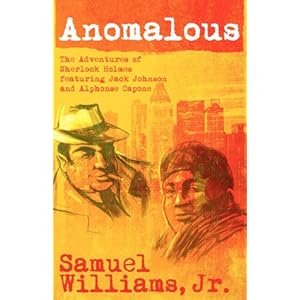 Anomalous by Samuel Williams Jr is an engrossing read, pacy, exciting and full of details that add rather than detract from the story and riveting characters such as Jack Johnson the heavyweight boxing champion and a certain Al Capone. The plot itself is involving, well-worked out and always captures both the imagination and attention. The major players are exremely well-portrayed and their dialogue is always, always convincing. A big plus, and it's not always so with pastiches, is how well Samuel captures the characters of Sherlock Holmes and Doctor Watson, the author knows his men, knows his canon and it shows. They are spot on in looks, character and voices, not always an easy thing to achieve by any means. The transition from 1912 America to 1913 England is seamless. Jack Johnson pulled no punches and neither does Samuel Williams Jr.......an inspired debut.
Anomalous – The Adventures of Sherlock Holmes is available from bookstores including in the USA Barnes and Noble and Amazon, in the UK Waterstones Amazon and Book Depository(free worldwide delivery) and in electronic formats – iTunes(iPad), Kindle, Nook and Kobo.
Thursday, 23 August 2012
The last of the series......
The upcoming 'Sherlock Holmes and the Lyme Regis Trials' is set to be the last in the series of Sherlock Holmes in Lyme Regis pastiches. Lyme Regis being such a small town (op. of probably only 2800 in Victorian times) makes it a hard task indeed to keep the believability of events occurring here which would necessitate the intervention of Holmes and Watson at regular intervals. The three novellas which make up the series (Horror, Legacy and Trials) take place in 1896, 1898 and 1903 respectively, I fear to increase the number of visits to the town by the pair would really stretch the limits of credulity and the series would limp on interminably, running out of steam slowly or even quickly! So as much fun as it has been (and it has been) it must end with 'Trials'. That is not to say it is the end of my scribblings for the next novel will be set in Scarborough and if the childrens illustrated book is recieved well ( coming soon folks) then, who knows, it may turn into a series, so the world has not heard the last of me...cue evil laugh. I would like to thank all those In Lyme who have supported me....and so manyn of them find themselves in the pages of the novels....in fact, there will be a list of those very people at the end of 'Trials'!!
All the Lyme Regis Holmes novels are available from Amazon etc and all good and even not so good bookshops.
All the Lyme Regis Holmes novels are available from Amazon etc and all good and even not so good bookshops.
Subscribe to:
Posts (Atom)